
March Pork Exports Third Largest on Record; Beef Variety Meat Value Reaches New High
March exports of U.S. pork were among the largest on record, concluding a very strong first quarter, according to data released by USDA and compiled by the U.S. Meat Export Federation (USMEF). While March beef exports were below last year – largely due to the ongoing lockout by China – the value of beef variety meat shipments reached a new monthly high, surpassing the previous record from January.
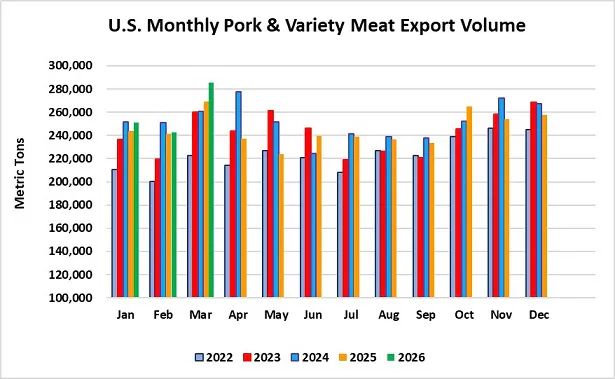
Pork exports totaled 285,567 metric tons (mt) in March, up 6% from a year ago, the largest in five years and the third largest on record. Export value increased 4% to $803.2 million, the second highest on record, trailing only April 2021. March exports increased year-over-year to leading market Mexico, as well as to Japan, Central America, the Dominican Republic, the Philippines and Taiwan. Shipments were steady to South Korea and Canada. March was an outstanding month for export value per head slaughtered, which was the third highest on record at $72.93.
Through the first quarter, pork exports were 3% above last year’s pace in both volume (778,939 mt) and value ($2.17 billion). Exports are on a record pace to Mexico and Central America.
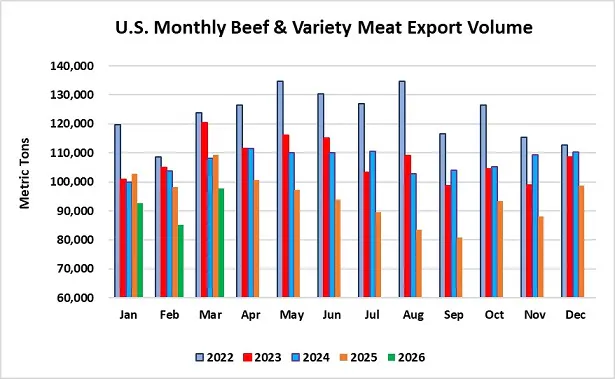
March beef exports totaled 97,731 mt, down 11% from a year ago, while value fell 8% to $844.7 million. Shipments increased year-over-year to Mexico, Central and South America, the Caribbean and Indonesia, and were steady to Korea and Taiwan. But these results were offset by minimal exports to China, and exports were also below last year to Japan and the Middle East. Excluding China, March exports were 4% above last year’s volume and increased 8% in value.
The March export results included 29,062 mt of beef variety meat, up 24% from a year ago and the largest since 2017. Variety meat export value increased 50% to $135.6 million, the highest on record.
March was a very robust month for per-head export value, which equated to $456.56 per head of fed slaughter.
Through the first quarter, beef and beef variety meat exports totaled 275,355 mt, down 11% from a year ago, while value fell 7% to $2.35 million. Excluding China from these results, exports were 3% higher than a year ago in volume and increased 9% in value.
“The sustained momentum for U.S. pork exports is impressive in the Western Hemisphere, but it is also encouraging to see demand climbing in key Asian markets, led by a welcome rebound in Japan,” said USMEF President and CEO Dan Halstrom. “On the beef side, while China has now been absent for more than year, the U.S. industry is making strides in other markets. The supply situation makes it difficult to grow export volumes, but exports are commanding strong prices. Expanding beef variety meat demand is especially critical, as this makes such a key contribution to the value of every animal.”
Monster first quarter for pork to Mexico, Central America and DR; strong rebound in Japan
March pork exports to leading market Mexico reached 103,808 mt, up 7% from a year ago, while export value also climbed 7% to $228.6 million. This pushed first-quarter exports to 309,137 mt, up 5% from last year’s record pace, valued at $688.1 million (up 8%). Mexico is a critical market for U.S. pork, especially bone-in hams and variety meat, and preserving market access is essential. This makes the review of the U.S.-Mexico-Canada Agreement a top industry priority, as well as Mexico’s antidumping investigation on U.S. hams and pork shoulders.
Fueled by steady exports to Honduras and growing demand in Costa Rica and El Salvador, March pork exports to Central America totaled 17,495, up 6% year-over-year, valued at $58.1 million (up 12%). First-quarter exports to the region increased 7% from a year ago to 48,920 mt, while value climbed 12% to $158.7 million.
After a slight volume decline in 2025, pork shipments to the Dominican Republic have raced to a rapid start this year. March exports soared 50% above last year, setting a value record of $35.8 million, while volume was the second largest on record at 12,478 mt. January-March exports totaled 29,984 mt, up 31% from a year ago, valued at $87.4 million (up 29%).
Pork exports to Japan declined last year but have rebounded in 2026. March exports totaled 35,448 mt, up 18% from a year ago and the highest since 2021, while value increased 13% to $134.3 million. First-quarter exports climbed 20% to 90,776 mt, valued at $345.8 million (up 13%).
Other first-quarter export results for U.S. pork include:
March pork exports to Korea were essentially steady with last year, declining 1% in volume (23,563 mt) but increasing slightly in value ($77.8 million). First-quarter exports to Korea increased 2% to 59,108 mt, valued at $196.3 million (up 5%).
Fueled by strong growth in the Philippines (where exports were the largest in eight months at 7,215 mt) and record-large shipments to Indonesia (440 mt), March pork exports to the ASEAN region reached 8,239 mt, up 41% from a year ago, valued at $18.8 million (up 32%). Through March, exports to the region increased 19% to 18,042 mt, while value was up 16% to $42.4 million. In addition to the Philippines and Indonesia, shipments also increased to Malaysia.
U.S. pork has faced numerous obstacles in Taiwan in recent years, but is regaining some traction in 2026. First-quarter exports more than doubled from a year ago in volume (3,585 mt, up 115% and the largest since 2019, while value increased 87% to $8.5 million.
In China, where U.S. pork is subject to retaliatory duties and domestic supplies have surged, first-quarter exports declined 9% from a year ago to 104,779 mt, while value fell 20% to $222.9 million. China remains the largest destination for pork variety meat exports, which account for more than 70% of total shipments to China.
March pork export value equated to $72.93 per head slaughtered, down slightly from a year ago but the third highest on record. The first-quarter average was $67.41 per head, up 2% year-over-year. Exports accounted for 33.1% of total March pork production and 28.8% for muscle cuts, roughly steady with the robust ratios posted in March 2025. First-quarter ratios were 30.7% and 26.8%, respectively – each up slightly from a year ago.
For the third time in four months, beef variety meat value reaches a new high
Global customers are increasingly seeking items that deliver excellent value, and U.S. beef variety meat is helping meet this need. After setting a monthly value record in December 2025 ($122.1 million), export value topped that total in January ($126 million) and again in March ($135.6 million, up 50% year-over-year). Export volume in March was 29,062 mt, the largest in nine years. Through the first quarter, beef variety meat exports increased 14% from a year ago to 80,654 mt, while value soared 45% to $367.6 million. Growth was driven by larger shipments to Mexico, Japan, Korea, Taiwan, South Africa, Peru, Colombia and the Philippines.
For beef plus beef variety meat, March exports to leading value market Korea were steady with last year at 20,729 mt, while value increased 3% to $209.9 million. January-March shipments were down 3% in both volume (56,242 mt) and value ($553.6 million). Although the changes did not impact first-quarter exports, Korea recently began accepting processed products made with beef from cattle less than 30 months of age. An export verification program was also removed following Korea’s lifting of residency requirements for cattle of Canadian origin.
Beef exports to Taiwan remained strong in March, matching last year’s volume at 5,078 mt and increasing slightly in value to $61 million. This capped an excellent first quarter – the strongest since 2022 – in which Taiwan posted a 22% increase in volume (14,909 mt), while value increased 14% to $168.4 million.
Other first-quarter export results for U.S. beef include:
The U.S. has exported larger volumes of beef variety meat to Japan in 2026, but fewer muscle cuts. The combined result is a 4% drop in export volume (57,396 mt) through the first quarter, while value was down 3% to $436.8 million. Japan remains the leading volume market for U.S. beef and ranks second to Korea in export value.
While March beef exports to the Caribbean were up less than 1% to 3,276 mt, it was the second highest volume on record. March export value climbed 22% to a record $36.9 million. Led by growth in the Dominican Republic, the Bahamas and the Netherlands Antilles, first-quarter exports to the region increased 5% in volume (8,996 mt), while value jumped 27% to $102.7 million. First quarter exports were on a record pace to the Dominican Republic, Bahamas, Netherlands Antilles, and Turks and Caicos.
Central America has followed a pattern similar to the Caribbean, with volumes increasing modestly but at soaring values. First-quarter exports to Guatemala climbed impressively in both volume (2,944 mt, up 18%) and value ($30.6 million, up 28%), with other markets posting increases in value. First-quarter shipments to the region increased just 1% to 6,100 mt, but value climbed 19% to $62.6 million.
Growth in Peru and Colombia pushed March beef exports to South America 30% above last year at 2,070 mt, while value soared 77% to $20 million, the highest since 2021. First-quarter exports to South America increased 21% in volume (5,382 mt) and 55% in value ($47.6 million).
March exports to the Middle East definitely felt the impact of transportation disruptions stemming from the conflict with Iran. Exports to Egypt were down 9% year-over-year but increased in value, as those shipments avoid the most troubled routes. But exports to the United Arab Emirates were just 127 mt, the lowest in eight months. March exports also declined to Qatar, Bahrain, Jordan and Lebanon. Through the first quarter, beef exports to the Middle East were 14% below last year at 12,027 mt, while value fell 12% to $57.1 million.
Beef export value per head of fed slaughter equated to $456.56 in March, down slightly from a year ago but the highest in 12 months. The January-March average was $431.66, up 2% from the first quarter of 2025. Exports accounted for 13.6% of total March beef production and 10.2% for muscle cuts, down from 14.8% and 12.5%, respectively, in March 2025. The first-quarter ratios were 13.1% of total production and 9.9% for muscle cuts, down from 13.8% and 11.5%, respectively, a year ago.
Lamb export volume lower in March, but value up slightly
March exports of U.S. lamb muscle cuts totaled 247 mt, down 11% from a year ago, but value increased 4% to $1.6 million. First-quarter exports were 9% above last year’s pace in both volume (811 mt) and value ($4.5 million). Growth was primarily led by the Caribbean, but shipments also increased to Central America and Asian markets.
Complete January-March export results for U.S. pork, beef and lamb are available from USMEF’s statistics web page.
For questions, please contact Joe Schuele or call 303-547-0030.
NOTES:
Export statistics refer to both muscle cuts and variety meat, unless otherwise noted.
One metric ton (mt) = 2,204.622 pounds.
U.S. pork and beef currently face retaliatory duties in China. In February 2020, China announced a duty exclusion process that allows importers to apply for relief from duties imposed in response to U.S. Section 301 duties. When an application is successful, the rate for U.S. beef can decline to the MFN rate of 12% and the rate for U.S. pork can decline to 37% (the MFN rate plus the 25% Section 232 retaliatory duty, which remains in place). But China imposed an additional 10% retaliatory duty on U.S. pork and beef on March 10, 2025, and additional retaliatory duties were announced in April 2025. China’s new retaliatory duties were first announced at 34% but were later increased to 84% and further increased to 125%. The additional tariffs pushed China’s effective duty rate on U.S. pork and pork variety meat to 172% and the rate for beef and beef variety meat increased to 147%. These rates were temporarily lowered to 57% for pork and 32% for beef on May 14, 2025, when the U.S. and China agreed to a temporary de-escalation to allow for further negotiations. The rates were further lowered to 47% for pork and 22% for beef on Nov. 10, 2025.
Beginning March 4, 2025, U.S. sausages entering Canada were subject to a 25% retaliatory duty. This duty was removed effective Sept. 1, 2025.